
- AI grounding
- RAG
- AI study app
- LLM products
- education technology
Why AI Study Apps Should Answer From the Student's Own Notes
An AI chatbot that answers confidently and wrongly is worse than no AI at all — especially for students who can't tell the difference. Here's how we grounded DuoDemia's tutor in the material it's actually asked about.
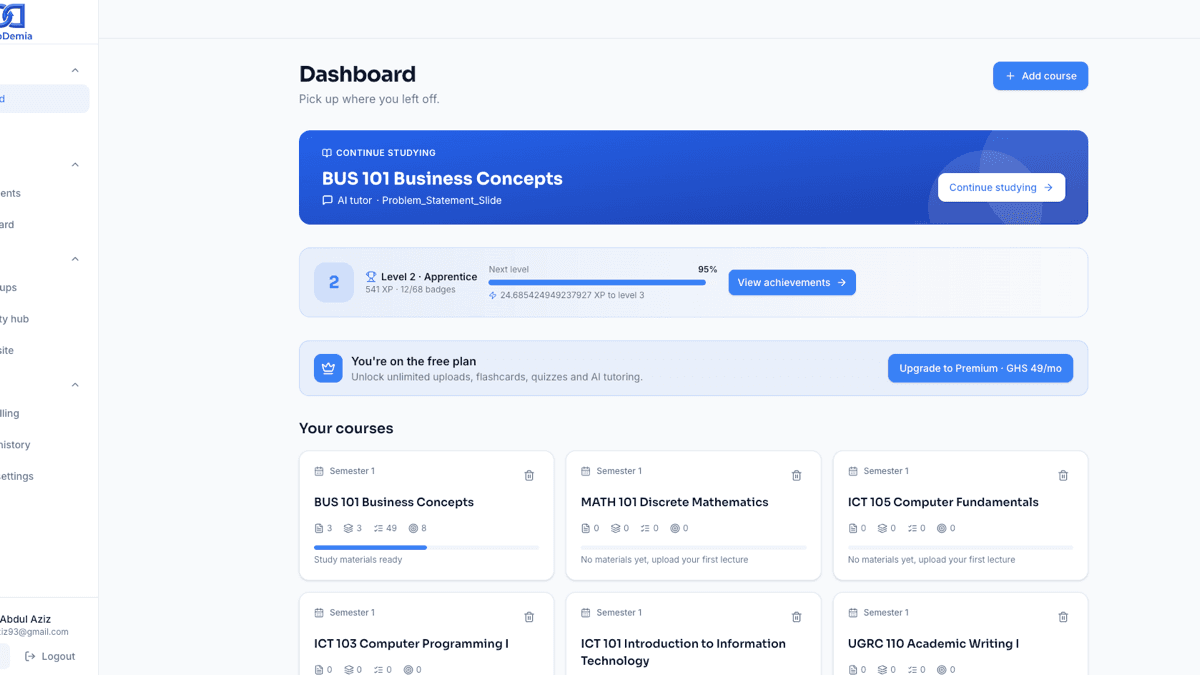
A language model that answers confidently is a lot of fun — until it's confidently wrong. In most products, a wrong answer is an inconvenience. In a study tool, it's misinformation that a student might carry into an exam. The frustrating part is that you can't design the confidently wrong answer out of a generic chatbot by prompting alone; you have to change where the answer comes from. That decision shaped the biggest product we shipped this year — DuoDemia, an AI study app that turns a student's own lecture notes and past questions into revision materials.
The problem with confident answers
Give a generic chatbot a question about a course and it will produce a fluent, well-structured answer — whether or not it's true. Professionals can usually sanity-check a plausible-sounding answer against what they already know or can look up. A student facing a question on, say, the money supply either hasn't covered that topic yet or is actively trying to learn it, which means they have no reliable way to tell a real explanation from an invented one. The failure isn't the model's inaccuracy — it's that inaccuracy is indistinguishable from success to the person who needs the answer most.
Ground the model in a source of truth
The fix we settled on is retrieval-augmented generation over the student's own documents. When a student uploads a lecture PDF, a slide deck or a set of notes, we chunk and index the text so the tutor can search it. When the student asks a question, the tutor retrieves only the most relevant passages from that student's uploaded material and constructs the answer from those passages — not from its general knowledge of the internet.
That part is fairly standard RAG. The part that matters for trust is the rejection path: when a question isn't supported by the uploaded material, the tutor says exactly that instead of inventing an answer. It's a small behavior, but it's the difference between a study tool that quietly fabricates and one a student can actually rely on. This is the approach running live at duodemia.com.
From answer to revision pack
Grounding solved the trust problem, but answering questions well is only half of studying. So we turned each uploaded document into a full revision pack: a short summary, the key concepts an examiner would likely ask about, likely exam questions, spaced-repetition flashcards and a practice quiz. As students practise, the system tracks their accuracy topic by topic and feeds that back into a weakness map — so the app points students at what to revise next instead of leaving them to re-read 80-slide decks.
Practising matters more than reading, so quizzes and timed mock exams are a first-class part of the product rather than an add-on. Students also wanted to study together, which meant adding groups, shared progress and leaderboards on top of the study packs.
What this taught us about building AI products
- Ground every answer in data you can point to. If the model can't cite the source, the user shouldn't have to take the answer on faith. The "where did this come from?" question should be answerable every time.
- Design the "I don't know" path as a feature. Most LLM products treat refusal as a failure mode to hide. We made it visible and deliberate — it's precisely what builds trust with users who can't verify answers themselves.
- Inputs aren't clean. Lecture decks are scanned, folded, covered in handwriting, occasionally upside down. A chunking and extraction pipeline that tolerates messy real-world documents is a non-trivial chunk of the engineering work.
- Measure outcomes, not just answer quality. We track quiz accuracy and topic mastery, because the product is judged by whether students perform better, not by whether answers look fluent.
A rule worth borrowing
The lesson generalises past education: if a chatbot answer can't be traced to something the person actually owns or verified, treat the invention risk as a product decision, not a model tweak. For any AI feature whose users can't reliably fact-check the output, a grounded, say-so-when-unsure design isn't a nice-to-have — it's the entire value proposition.